
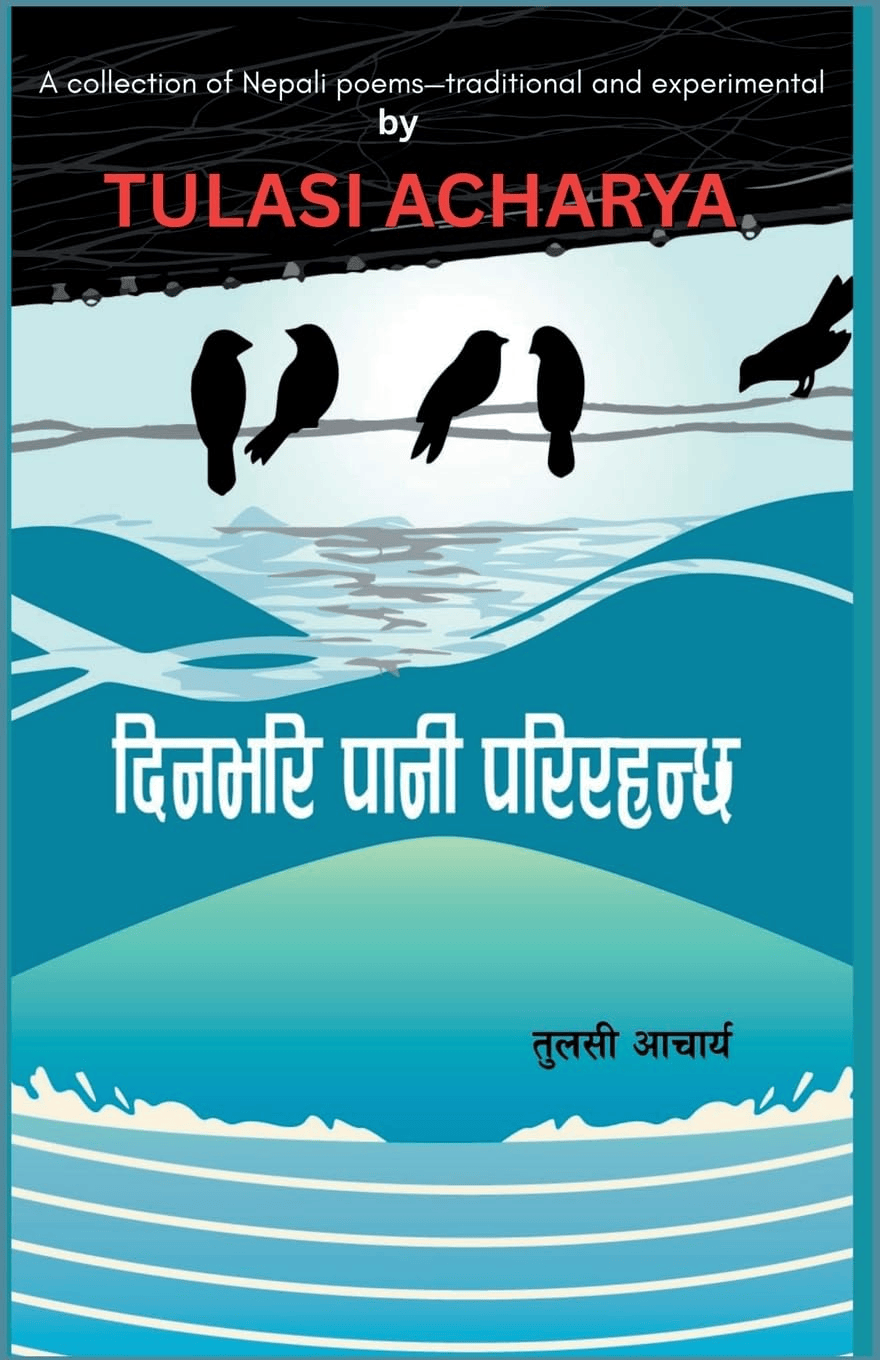
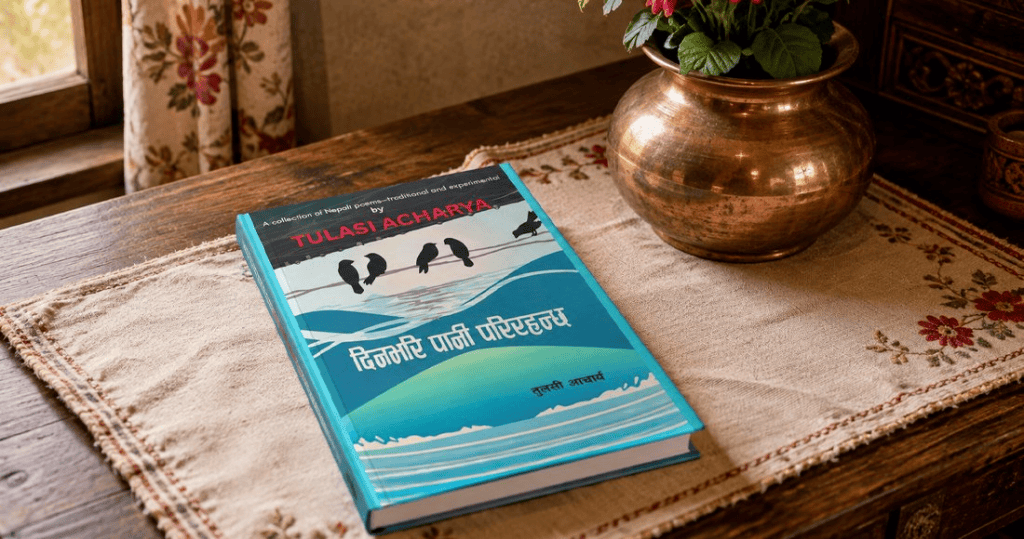
It is currently August’s sweltering hot season in South Bend, Indiana, USA. Today, however, there is light cloud cover. A gentle breeze is blowing from the maple trees. I, who prefer reading and writing outdoors rather than in a closed room, am sitting today on a chair placed under a maple tree by the University Campus Housing, and have sat down to write something about poet Dr. Tulasi Acharya’s poetry collection ‘Dainbhari Pani Parirahancha’.
The poetry collection written in Nepali language is divided into five sections: traditional, memoir, essay, sketch, and short poems. The poet began his journey with traditional style poems. What a coincidence – the first poem in the collection is ‘Rukh’ (Tree), and I too am sitting under a tree at this very moment, reading poetry.
As I read the poem ‘Rukh’, the poet’s study, research, and intellectual depth are clearly felt. Centered around the tree, the poet presents its multifaceted importance. Subjects ranging from science to art, Vedanta to cruelty are easily accommodated in the poem. The enlightenment attained at the foot of the tree, Newton’s theory of gravity after an apple fell from a tree, the history of martyrs hanged from trees, and Anne Frank’s view of a tree from her window. Reading all these episodes through the poem awakens one scene after another in the reader’s memory.
Strange, it revolves around the tree
Enlightenment, barbarity, destruction, Vedanta,
Theory, conspiracy, history, cruelty
And all of human existence.
After reading these lines, I, sitting at the foot of the tree, looked at the swaying branches above and the leaves rustling with the wind, and smiled.
In most of the traditional style poems, the poet has artistically depicted his home and family, Nepal, Nepali society, and contemporary events that have occurred in Nepal. Perhaps because he is living abroad, the poet repeatedly expresses his deep love and longing for his motherland in his poems. Titles such as ‘Dashain in a Foreign Land’, ‘My Father’s Cap’, ‘Letter to Father’, ‘The Scent of Dashain’, ‘When Monsoon Arrives in My Country’, ‘After All, I am Nepali’, ‘Father’s Heart’, ‘Living Mother’, and ‘Dedicated to Grandfather’ are enough to infer the poet’s love and affection for Nepal.
Through these poems, the poet has expressed his childhood, village environment, festive cheer, and family intimacy in a very poetic style. Especially, the poet’s remembrance of Dashain seems very deep. The poet has not just remembered Dashain; he has compelled the reader to drown in remembrance as well. Perhaps due to that emotional depth, the poet may have written two poems on the subject of Dashain with different titles.
It has been a full year since I myself came to America. While reading the poems, I felt nostalgic for my village and at times consoled myself by thinking that life is just like this. In the poem ‘My Father’s Cap’, the poet writes:
Sitting on my father’s head, it has
Felt more sun than I have
Walked more than I have
Endured more springs than I have
Carried more sorrow than I have
Yet it has walked with pride
Never bowed down while sitting on the head
Has not forgotten its dignity.
While reading these verses, who among Nepalis wouldn’t remember their father’s cap? I too remembered my father’s sweat-soaked, worn-out cap. Now when I go out, I wear perfume. The scent of the perfume I sprayed this morning still lingers from my shirt. But alas, my heart seeks the scent of my father’s sweat more than the perfume. Where can that scent be found in any perfume!
Also, the poet is a researcher of social sciences. Therefore, perhaps, his poems also reflect contemplation of society. In the poem ‘Nirmala’s Cry from Heaven’, the poet has sharply warned through poetry about the tragic rape and murder of Nirmala Pant. The poet says:
I will say
To bloom even more
To give birth to daughters and raise them
Stir yourselves so that
Every particle around you
Before reaching you
Asks once
Takes your permission.
The poet has made the traditional style section not only serious but also amorous and witty. Through a fictional lover, a young man expresses the full essence of love felt in his youth, exactly as it is in the poem. Poems with titles like ‘Fictional Lover’, ‘Waiting’, ‘Your Memory’, ‘Memories’ etc. are full of romantic sentiment. The waves of love that come to a young man’s mind when he misses his beloved, the moment of waiting for the beloved are vividly portrayed in these poems.
Now let’s talk about the memoir style poems in the next section. This section begins with the poem ‘Dainbhari Pani Parirahancha’ and the collection is named after this poem. In this poem, the poet has very vividly presented the memory of his motherland, childhood experiences, and the impact of those memories on his mind while living abroad. The poet writes:
My childhood flows in that rain
Drenched in the rain, playing around while getting wet
Covered with a shawl, rushing to the fields to plant paddy
My sister and I, uprooting paddy seedlings and making bundles
………………………………………………………………………………………………………………
I close my eyes for a moment and take a breath
I feel drenched without crying.
These lines show that for the poet, rain is not just a natural phenomenon, but also a medium of memory. The rain falling in America reminds the poet of Nepal’s monsoon, fields, childhood, and family. For this reason, these poems are not limited to being just the poet’s personal experiences; rather, they allow the reader to reconnect with their own childhood, village, and past days. This is the greatest strength of this section.
Another feature of this section is the poet’s effective use of places, objects, and surroundings in the state of Georgia, USA, as powerful imagery. The streets, downtown, apartments, seminars, poplar trees, lakes, weather, snowy days, etc. of Georgia have not just appeared as scenes in the poems; each of them is linked to the memory of Nepal. Every scene from abroad turns the poet back towards his own country. This conflict – the present here and the memory of there – is continuously seen throughout this section.
Reading most of the poems in this section, I felt like I was wandering the streets and alleys of Georgia myself. The beauty of poetic depiction is that as much as the poet describes foreign lands, every poem ultimately concludes in Nepal. The final destination of the poem has always been one’s own motherland. Expressing a strong desire to return to Nepal, the poet writes in the poem ‘Promise to Return to Nepal’:
Parents in their eighties, waiting to live comfortably
Are waiting for their children to return home
I remember, watching the setting sun
My eyes well up, as if a spring of water has burst
A car behind honks
Overtaking, the driver makes an angry gesture
Only then I realize
I had unknowingly driven my car into his lane
I jolt and grab the steering wheel,
Wiping my eyes as if covered in fog
I focus on the road again
But in my mind, only one thing keeps playing
I must return to Nepal as soon as possible.
In this poem, the poet has not only expressed the desire to return home; but has also woven into words the constant conflict in the minds of Nepalis living abroad. The poem vividly portrays the reality that even though the body is abroad, the mind remains entangled in one’s own village, family, and soil. The poem depicts the reality that even though the body is abroad, the mind remains entangled in one’s own village, family, and soil.
Overall, these memoir-style poems are not just a record of memories; they are also a poetic archive of time, distance, change, and human emotion. Reading these poems, it feels as though no matter how far a person travels, they can never be truly distant from their birthplace, childhood, and family. Memory repeatedly draws a person back to their roots, and this truth has been expressed very sensitively by the poet in this section.
Now let’s talk about the essay-style poems. Another special attraction of this collection is the essay-style poems. It felt like a new and bold experiment in Nepali poetry. At first glance, these poems look like paragraphs or essays. But as you read, you realize they are not just prose; they are a confluence of thought, emotion, and poetic sensibility. In the essay-style poems, a deep balance of thought, logic, and personal reflection is found.
In the poem titled ‘For Those Who Said I Forgot My Country’, the poet writes:
Why does a person go abroad?
You never asked
These few lines highlight the mental conflict that Nepalis living abroad often face. Is going abroad a choice or a compulsion? Can patriotism be measured solely by physical presence? The poet leaves such questions to the reader. This is perhaps the characteristic of the essay style; it generates more questions than answers.
Another interesting section of this collection is ‘Shabdachitra’ (Word Sketch). This is a very attractive and creative experiment in Nepali poetry. Here, the poet has not only used words; but has also made the visual structure of words an integral part of the poem. That is, the poem can be not only read but also felt through visuals.
For example, in the poem titled ‘New Year’s Resolution’, the lines of the poem are arranged in the shape of a wine glass. This is not just a visual experiment, but is also deeply connected to the theme of the poem. The poet writes in a satirical style:
Drinking alcohol, I said the New Year is coming,
I will quit from that day.
This satire on human weakness, self-deception, and unfulfilled New Year’s resolutions in just a few words is very effective. The last section of the collection is ‘Short Poems’. After reaching this section, the impact of the poem is determined not by the number of words, but by its depth. The poet’s real strength lies in being able to express philosophical, social, and political messages in a few words.
In this section, poet Acharya has presented very sharp, well-structured, and meaningful poems, avoiding lengthy descriptions. After reading each poem, one feels like pausing for a while because those poems continue to converse with the reader. In the poem titled ‘Geometry of Life’, he says:
When everything is taken away
And life reaches emptiness
From there begins
Pure geometry.
Taking emptiness as the center point
The circles of life begin to be drawn
And in those circles begin to form
The angles of triangles and rectangles.
From there, a new science of life is drawn
Where the sum of three angles
In the triangles of life
May not be 180 degrees.
Connecting mathematical principles with the philosophy of life in this way is the poet’s originality. The poet has conveyed the deep message that the rules of mathematics learned in school may not always apply in life, in a very simple yet effective way. This poem gives the feeling that the real geometry of life is very different from the geometry learned in books.
Overall, these three sections do not limit ‘Dainbhari Pani Parirahancha’ to just a poetry collection; they also make it special in terms of stylistic experimentation, conceptual depth, and artistic innovation. The presence of so many styles and presentations within a single collection is itself a strong aspect of this book.
The most outstanding aspect of the poetry collection is the poet’s ability to express complex emotions in simple language. There is philosophy somewhere, history somewhere, love somewhere, social rebellion somewhere, but nowhere does the poetry feel burdensome. While the poems have poetic sweetness, the emotions and themes in some poems of the collection feel repetitive. In poems like ‘Rukh’, ‘Story of an Old Tree’, ‘Poplar Trees’, ‘Trees in Search’, ‘Waiting’, ‘Age’, and ‘Old Age’, the expressed emotions, symbols, and imagery feel repetitive to the reader.
Another point is that in the memoir-style poems, the poet has used a lot of English words. Readers may not have a uniform opinion on this. To me, it did not seem natural. I would like to leave the responsibility of reviewing how this affects the linguistic beauty of Nepali poetry to linguists and literary critics.
Reviewed by Suraj Parajuli. The book is available on Amazon and elsewhere.
(Parajuli is pursuing a Master’s degree in Global Affairs at the University of Notre Dame, USA.)


Leave a Reply