
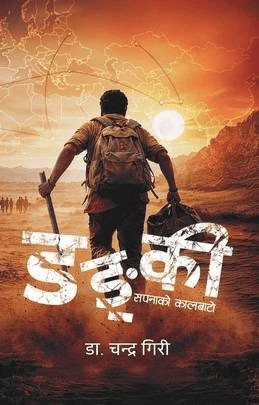
I have just finished reading Dunki, an emotionally moving and stirring Nepali novel. The flow of the story is beautiful. It moves like a river flowing gently along its course. Particularly after Pashupati returns to Nepal and begins another journey, the novel becomes a page turner. Every line, every paragraph, and every page keeps drawing the reader in. That is the power of the story. The author’s writing style is also mature and accomplished.
The novel is primarily about people who attempt to reach America—the land of their dreams—through the so-called “dunki” route, or illegal migration route. Many stories of this kind have already been written in different languages, both as fiction and nonfiction. Yet, as I read this book, I was reminded of a Nepali man who lived as my roommate for six months about a decade ago. He, too, had entered the United States through Mexico using an illegal route. One night, he spent nearly five hours telling me about his painful journey. He described how it took him roughly forty-five days to enter the United States, how he was subsequently held in a detention center, and the unbearable suffering and countless twists and turns he endured along the way. As I read this novel, all those scenes came vividly back before my eyes. It was as if that friend were sitting in front of me again, telling me his own story.
Perhaps that is why my connection with this novel became even deeper. It made a story I had already heard feel even more vivid and immediate. Stories of life become most powerful when readers can see the scenes unfolding before their own eyes, connect them with their own emotions, or compare them with their own experiences. When a story connects with something one has personally experienced—or with what people around us have experienced—its impact becomes even stronger. That is one of the reasons I found this novel so compelling.
I do not want to reveal the entire plot here. It is better for readers to discover and experience it for themselves. I will say only this: it is a story of the struggle, pain, fear, and hope of people who set out in pursuit of their dream of reaching America through an irregular migration route. At several points, I became deeply emotional. I even shed tears. After roughly forty or fifty pages, the story begins to deepen emotionally. Through Pashupati’s journey, the author raises an important question: What makes a person leave their country? Why would someone who is living an ordinary life as a teacher in a government school be compelled to take such an enormous risk? The novel offers a poignant portrayal of these questions.
As I mentioned earlier, stories of this kind have been written in other languages as well. There are also several English-language novels dealing with similar themes. I myself have written an unpublished story on this subject. Many Mexican immigrant writers have incorporated similar experiences into their nonfiction. Whether in the Hindi film Dunki, B. N. Joshi’s Shramatan, René Grande’s nonfiction Migrant Heart, or Imbolo Mbue’s Behold the Dreamers, the subject has been addressed either directly or indirectly in different ways.
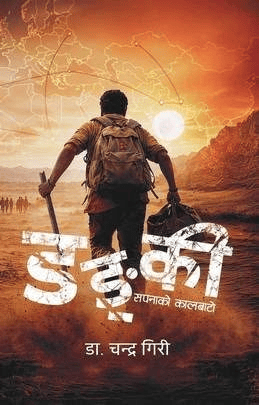
What distinguishes this novel, however, is that it offers a remarkably detailed and vivid portrayal of the journey of Nepali characters traveling to America through an irregular migration route, within the context of Nepali society and in the Nepali language. It is perhaps one of the first significant attempts to portray this experience in such depth. That is where its originality lies.
Another important strength is the extensive research undertaken by the author. Because the novel is written in the first-person point of view, the narrator’s suffering feels almost like the author’s own lived experience. This makes the story more intimate, credible, and emotionally profound. Had the same story been written in the third person, it might not have had the same impact.
The author has conducted research on various countries and locations. In the concluding pages, the author also mentions personally visiting places and connecting with people to gather information. Therefore, this novel is not merely a story of emotion; it also provides substantial information about different places, people, routes, cultures, social realities, and historical contexts. In that sense as well, it is a book worth reading.
Nevertheless, toward the end, the novel felt slightly longer than necessary. In my view, the story might have been even more powerful if it had ended after Pashupati entered the United States through Texas, arrived at a gas station, or somehow settled in Baltimore. Some of the episodes that follow seem to suggest that the author wanted to explain everything in considerable detail.
I think the novel might have been even stronger if some things had been left to the reader’s imagination. In particular, the immigration-related events following Donald Trump’s second term, the immigrants arrested by ICE, the details of detention camps, and so forth could perhaps have been presented more briefly, merely through suggestions. Even a scene in which someone watches a television news report about these events might have been enough to give readers a sense of what was happening, allowing them to imagine the rest for themselves.
Leaving some space for their imagination and intellectual participation could have made the novel even more effective. Perhaps it would also have left a door open for another possible story.
Similarly, I felt that the author could have been a little less harsh on the character of Pashupati. Even if the story is based on real events, once it becomes a novel, I believe the writer must also take the reader’s emotional expectations into consideration. Readers, too, develop expectations and hopes for the characters, and those hopes should not necessarily be allowed to die.
That is all I will say. I do not want to go into too much detail and risk giving away the story. Read it yourself.
Apart from these few minor observations, Dunki is a successful contemporary Nepali novel that presents the subject of migration in an exceptionally vivid, sensitive, and well-researched manner. It is not merely the story of one person’s journey; it is a story of dreams, struggle, pain, hope, and human resilience.
For these reasons, I highly recommend Dunki as a novel worth reading.


Leave a Reply