
Travelogues, or travel essays, or travel memoirs, or you name them, not only reflect on the author’s experiences, but also take you on a tour with the writer. It can, not only remain a physical journey, but also becomes a mental, emotional, and psychological sojourn that takes us to the events, incidents, and scenes the author experiences for us to picture, relate, and reflect. The more vivid the prose is, the more it becomes memorable. One of the widely known Nepali travel prose I have read so far is “Belayat tira Baralida,” meaning wandering Across the United Kingdom by Tara Nath Sharma. It remained memorable because it was vivid and relatable to the author’s subjective experience. Since then, we have hundreds of thousands of Nepali people who have travelled the United Kingdom or other countries across the world, and many of them have directly or indirectly written on and about them. Experiences change over time, as a country itself changes, more or less, in its color, creed, culture, socio, cultural and linguistic milieu. Thus, any experience an author goes through in the course of visiting those places will remain fresh and new. Heraclitus says that we cannot dive into the same river twice. Every time it is new.
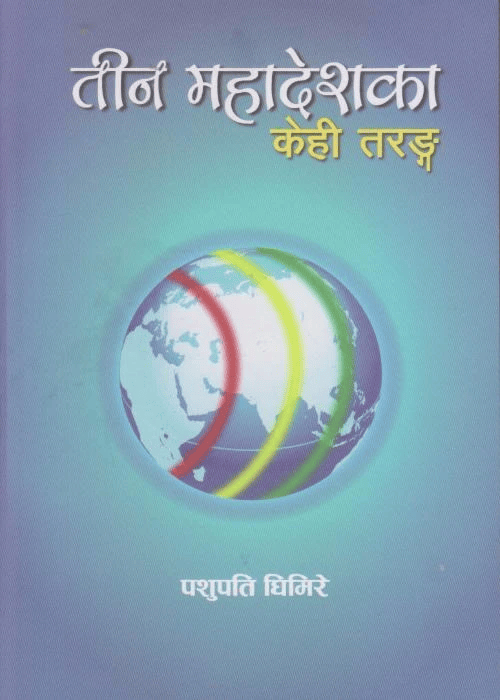
Writing a travelogue or travel prose is not only about what one saw or found, but also about how those places helped the author awaken inside them. With that said, the book “Tin Mahadeshka Kehi Tarang,” meaning some waves of three continents by Pashupati Ghimire remains an example of bringing those fresh experiences of visiting the places across three contents. The author not only talks about the places he visited but also becomes contemplative as he wonders and wanders across enigmatic places. He shares his meditative experiences and compares them with his own country of origin that let the reader relate to the author’s experiences.
This book is a travel journey of the writer with his family— his wife and their children—most of the time, starting with a North American country, Mexico and its famous Cancun city to Puerto Rico to Las Vegas and The Grand Canyon in the US to the Bahamas. Then the author moves onto the Asian countries, India and Nepal and South Korea, and finally wraps up with the European countries, such as France, Switzerland, Greece, and the United Kingdom —basically the book gives an impression of almost the whole world. The book brings the experiences and discussions of many subjects and topics that we have heard but never seen, that we have seen on the screen, but never known their stories behind the scenes. Putting many stories to the foreground, the author highlights interesting experiences: whether that be the author’s journey to the planet while visiting NASA, or that be the “emotions of Las Vegas” through its people and places or that be the ditches or hills of Grand Canyon or the gigantic carnival cruise on the way to Bahamas or be those places in India, such as Banaras or Brindaban or be the author’s own country and its places- the birth place of Gautam Buddha or Pokhara.
Wherever the author goes, its place, time, and the situation shape the author’s mindset. As he visits spiritual places, the author appears to have spiritual contemplation in his experiences and emotions and ideas as he shares with us in his prose. At times, bad experiences in the journey give the author good lessons and help him relate to the art of living to compromise with certain things in life. On a trip to Las Vegas, the author’s wife Barsha misses the train, and he has to come back to get her. It takes him a while to woo her since she was upset about missing the train, and he beautifully describes how that could be a beautiful moment and the opportunity to show love for his wife. A literal journey with a good partner could be an emotional, intellectual, and spiritual journey in a relationship as well—the writing expresses so metaphorically.
At times, some places remind the author of his place of origin, i.e. Nepal; the author cannot help comparing and contrasting, reflecting on his own diasporic experiences—that comes out naturally for any writer living abroad carrying a Nepali heart within himself. Nepali words at times, Sanskrit lines in writing, or Nepali songs carry cultural emotions and patriotic feelings within the prose. This becomes a reawakening experience within the author himself. In her book “Migrant heart,” Reney Grande writes that writing is an experience, a response to the previous experience or a sort of a political reawakening. This is something Ghimire’s writing does.
Ghimire is very sympathetic and anthropomorphic in feelings. He has senses and sensibility; he talks to the taxi drivers and acknowledges their stories as well. He respects people, places, and their cultures. He tours and travels with his family and parents. At times, his three generations travel. Each chapter is thoughtful, highly informative, and a tour guide, filled with the author’s experiences and emotions. Himself a researcher and writer of the book of “Buddhabadaka Tin Aayam,” meaning three dimensions of Buddhism, Ghimire has thoroughly and clearly shared his experiences of the birthplace of Gautam Buddha and the places around. His Paris visit is extremely fascinating and enigmatic and highly informative. When he comes to visit Switzerland, it is so interesting to see how the country itself is comparable with Nepal here and there. When he talks about Greece and some places with even worse issues than Nepal, at times, putting some sense of humor not only brought a smile to my face but also gave me insight into it. His anecdote about Winston Churchil is funny and thoughtful that made me laugh and contemplate simultaneously.
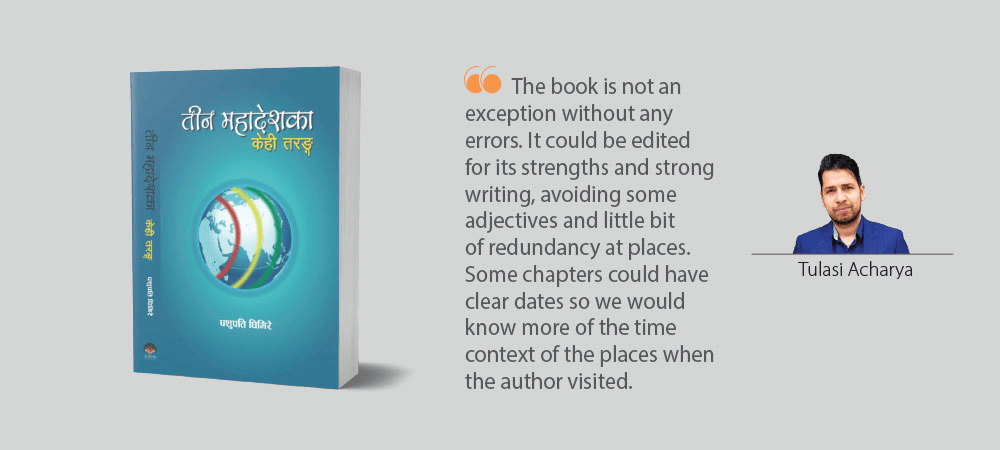
With all of those strengths, the book is not an exception without any errors. It could be edited for its strengths and strong writing, avoiding some adjectives and little bit of redundancy at places. Some chapters could have clear dates so we would know more of the time context of the places when the author visited. I also wanted to read more of the author’s subjective experiences and scenes and descriptions—showing more than telling. It could be my personal preference though. Overall, this is an insightful and enlightening read, and I recommend this book if you are going to be on a tour of those places or just traveling the world lying on your bed without going anywhere. Kudos to the author.


Leave a Reply