
How many of us have access to the distribution of government services? How many Nepali citizens among us can or do consume these services easily? Are government services and facilities available to every citizen? The real status of the country, economic and social progress, and political success lie in these answers, especially when leaders boast that they have built or changed the country.
Does a citizen living in the city, particularly in Kathmandu, have the same access to government services, facilities, or consumable goods as another citizen living in Olangchung Gola? Furthermore, what is the difference in access to government facilities between a person close to a leader, an affiliate, an economically strong and capable individual, a male, or a person from an upper-caste community, versus a poor person, especially a woman, a disabled person, or someone living in a geographically remote area?
While discussing the possibility of an egalitarian society, the questions raised above become important. If we cannot make government service delivery effective and egalitarian, discussing change or constitutional amendments becomes ridiculous. Even with the establishment of provincial governments, citizens from remote areas still have to come to Kathmandu for many government services. If there is a known government employee or leader, the work can be done with a phone call without even going to the office. But if that citizen has no connections, they have to visit the office many times and often fall prey to intermediaries.
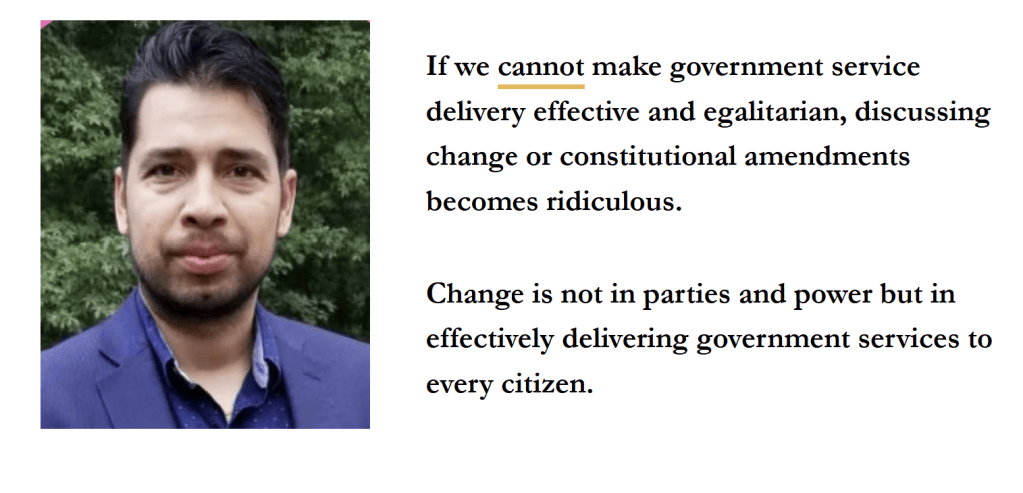
If we cannot make government service delivery effective and egalitarian, discussing change or constitutional amendments becomes ridiculous.
Change is not in parties and power but in effectively delivering government services to every citizen.
In reality, essential and mandatory services provided by the government seem to have become more fragile than in the past. For example, about 25 to 30 years ago, postmen used to deliver letters to villages, ringing their bicycle bells. Now, citizens have to find and reach the concerned place themselves. The same is true in Kathmandu, let alone in villages. In the USA, postmen deliver letters to homes daily.
Letters are not only personal information but also a powerful medium of communication through which the government disseminates information and news about its services and facilities. Similarly, every company or organization communicates messages related to various business advertisements, opportunities, and challenges, which technology alone cannot do. Has the government understood the importance of the postal service?
Similarly, considering geographical remoteness as an excuse, the government has not been able to do any effective work. A woman in Karnali has to die because she cannot reach the hospital on time during pregnancy. In Humla Jumla, a patient has to die of fever because they can’t get paracetamol. Many citizens have to wade through rivers, often using the help of Tuhins. They still have to carry salt loads uphill. People have reached the moon, but we see a sky-ground disparity in just a 25 to 26 km distance within our country.
Problems with roads, electricity, and transportation are as pervasive in remote village life as ever. If you don’t believe it, watch Vidhya Chapagain’s “Herne Katha” to see how egalitarian the Nepali government has become. Social security and poverty alleviation programs are nominal. Some programs run on the reliance of NGOs and INGOs seem more focused on capturing foreign dollars. In a country called an agricultural country, imports exceed exports. There is no facilitation or appropriate environment for farmers. Many youths are migrating for employment, leaving fields fallow. The number of children and elderly dying from floods and landslides increases every year. The local government, established in the name of decentralization, is self-centered, with its inability to reach local and remote areas.
In the name of public-private partnership, the private sector working with the government is also dominated by interests, favoritism, and nepotism. Works that should have been completed on time are not finished even after years. The fast track from Terai Madhes to Kathmandu is still “under construction.” Whether it is hydropower projects or airport construction, nothing shows positive signs even after a decade, whereas these could have been completed in a year.

Even though the government claims to have adopted a new management style, the neurotic tendencies of leaders who keep the same leadership in power have not been able to decentralize power. Its impact is seen in the administration and its delivery, which is slow, irregular, irresponsible, and tedious, adversely affecting marginalized communities. Cooperation and collaboration are emphasized in government operation and public administration delivery, but it is more like “eating the cock among the blacks” than real collaboration and cooperation. The services are not citizen-oriented. Those without access are always left behind.
The government has not been able to effectively implement policies ensuring no one is left behind. Nothing new has come. It’s just the same old liquor in a new bottle. Public administration has not been able to enhance its capacity. Resources are just as scarce. The world has progressed, but our administrative structure is 100 years old. In developed countries, many theories have replaced the old theory to reform the administration. In our country, a whole era has passed moving from one window to another, then another, and back to the same window or under-the-table dealings. They have not yet been able to practice how to motivate employees and deliver services quickly and effectively to citizens. What could be more heartbreaking than this? Change is not in parties and power but in effectively delivering government services to every citizen.
Author: Dr. Tulasi Acharya
(Dr. Acharya is the Director of the Sociology Department at NIRI and a Professor of Public Administration. His book Sex, Desire, and Taboo in South Asia has recently been published.)


Leave a Reply