
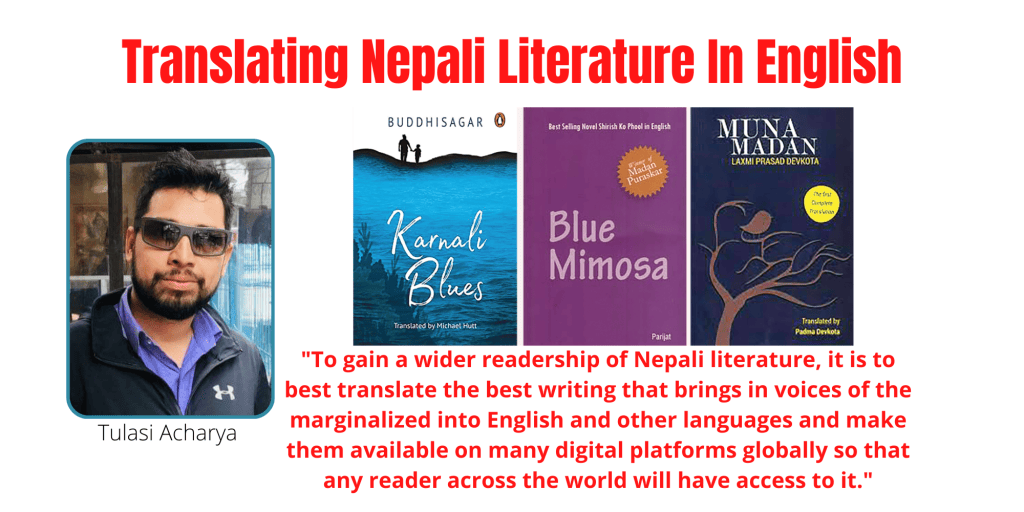
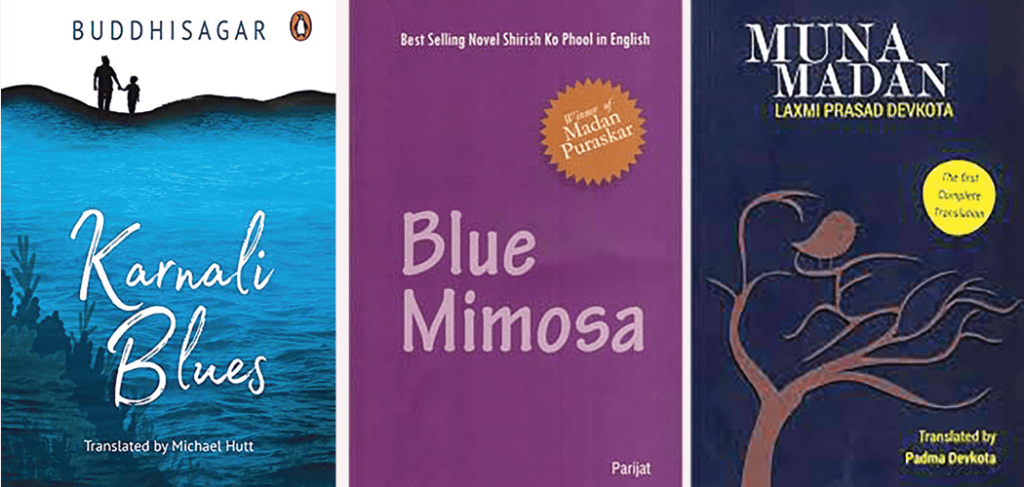
Along with the publications of different genres, one can experience a plethora of translation of Nepali writings into another language, especially English. According to Padam Prasad Devkota (2022), “The bulk of Nepali literature in English consists of translations and original compositions in English.” Adhikari (2016) writes, “As to English-Nepali translation, it’s almost a century-old phenomenon. Nepali-English translation, on the other hand, has only crossed five decades. Shyam Das Vaisnav’s collection of poems Upahar is the first Nepali literary writing to be translated into English. Laxmi Prasad Devkota translated it under the Present in 1963.” Although there were some translations in the time of Laxmi Prasad Devkota who himself translated many of his books and others into English, there was not enough amount of translation. Muna Madan was first translated in 1970. Some of Devkota’s English translations were also published in Indreni, a poetry magazine then.Many of the books by different writers were translated later, such as Pallav Ranjan’s translation of Devkota’s “The Pilgrims” (1995), Madhav Prasad Ghimire ‘s “Ashwatthama” (1998), Parijat’s novel, “Blue Mimosa,” (1972), Diamond Shamsher’s “The Wake of the White Tiger,” (2011) Bharat Jangam’s “The Black Sun,” (1990), and so on.
Current translation
Most recently, there are many literary works being translated into English, such as Padmavati Singh’s “Parallel Sky,” Govinda Raj Bhattarai’s “Muglan,” and BP Koirala’s “Narendra Dai,” Niraj Bhattarai’s “Threads of Smoke,” Bhisma Upreti’s “Kathmandu Kaleidoscope,” Sanjeev Upreti’s “Another Cultivation of Maize,” Krishna Dharabasi’s “Radha,” Chuden Kabimo’s “Song of the Soil,” Buddishagar Chapai’s “Karnali Blues,” or the coming out soon ones, such as Nayan Raj Pandey’s “Ular,” Amar Neupane’s “Seto Dharti” and the list goes on and on. If one looks at the proliferation of translations currently, Acharya (2020) writes that the future of Nepali literature and its English translation is promising.
Future of translation
According to Hodgkinson, chair of the judging panel for the 2020 International Booker Prize “Much of the most exciting, playful and inventive new fiction can be read in translation.” If the translation fails to bring in such playfulness in writing, whether original or translated, it fails to woo the reader. Hodgkinson looks for “compulsive stories, haunting characters, a finely tuned voice” that makes one see the world afresh. But with translated fiction, he further adds there are several added dimensions, such as whether a translator is making to evoke a “distinctive authorial sensibility in English.”
Translation is difficult if one fails to handle the original text in its own culture. It is more than a literal one. Our cultures and cultures are composed of many overlapping stories that the translations need to be wary of.
On this note, one can notice that most of the fictions that have been awarded international literary prizes carry such playfulness and freshness in writing, for example, Marieke Lucas Rijneveld’s The Discomfort of Evening or the most recent International Booker Prize Winning novel, a translated one, Tomb of Sand by Gitanjali Shree. Both bring playfulness in writing. The former gives a lot of details that the readers themselves feel being in the dairy farm. It portrays the rural life so beautifully and the relationship with the family and family members. The latter reflects on mother-daughter, parent-child relationship. The reader can glimpse the translator’s grasp of Shree’s exultant word play and hear the original Hindi cadence of the novelist. It shows that the success of the good translation of a novel or writing a novel in its original form can be measured in terms of the characters’ lives and relationships, playfulness of language, and making the story come to life. That also might be the reason why Buddisagar’s Karnali Blues, a story about the relationship of son and father, have drawn the attention of many readers and have also been translated into English by Michael Hutt. In the interview by Flyn (2020), Hodgkinson says, “a fine translator can calibrate your ear to the inflections and nuances that make a character come to life. A good translation captures the idiosyncrasies of the original novel without being slavishly literal. It enters the creative spirit of the author’s vision.”
Despite some challenges, regarding the future hope of translation, Abhi Subedi (2019), “The lure of English is also associated with the new energy. Some Nepali writers write with near-native proficiency. Some well-known among them live abroad. There is a great interest in translating Nepali literary works, especially poetry, into English to reach out to the wider readership. But there are problems in this direction. Apart from a few good translations, this euphoria could give the opposite picture of Nepali literature. But the efforts of individuals and organizations are underway.”
Challenges
Translation is difficult if one fails to handle the original text in its own culture. It is more than a literal one. Our cultures and cultures are composed of many overlapping stories that the translations need to be wary of. In a video “The Danger of a Single Story,” a novelist Chimamanda Adichie (2009) tells the story of “how she found her authentic cultural voice — and warns that if we hear only a single story about another person or country, we risk a critical misunderstanding.” Again, Hodgkinson says, “A good translation makes it possible for you to enter these worlds without any profound cultural knowledge of the places that you’re going to, though you might acquire it as you go. A good translation enables that journey and renders you fluent in another culture.” A good translation makes the reader feel familiar and something innovative at the same time. In this context, Yashee (2022) gives an example and writes, “one of the reasons to pick up Ret Samadhi, or Tomb of Sand, is its refreshing wisdom and cadence, which will feel new and familiar at the same time.” Until one brings such cadence, playfulness, and profound cultural knowledge in writing, it will be very hard for Nepali writing—whether in English or translated into English—to enter the cannons of Nepali writing in English. Bala Ram Adhikari, who holds a Ph.D. in translation and, also, teaches and does translations opines translation as “a technique, not a method.”
Conclusion
Translation is a difficult task to do. It demands a lot of hard work and research. It wants the translator to walk in the shoes of the original writer and the society the writer lived. Therefore, a good translation of a good book is a must. Translation should not only be of language translation, but the translation of ideas and emotions that must conveyed effectively through dialogue, description, and details. Also, translation in as many languages as possible can broaden the wider readership. To gain wider readership of Nepali literature it is to best translate the best writing that brings in voices of the marginalized into English and other languages and make them available in many digital platforms globally so any reader across the world will have access to. Nepali literature still is waiting for good translation. In this context, publishers should encourage to not only focus on translating Nepali to English or English to Nepali with an idea that it would help our literature and culture travel, but also should focus on translating other languages into Nepali for Nepali literature to grow more. International literary organizations and the organizations like NRNA (Non-Resident Nepali) should equally play a crucial role for good translations of Nepali literature. Mahesh Paudyal (2019), a critic and translator, writes about the importance of translation for Nepali writing to receive more attention and visibility in the world.
Published in the Rising Nepal here dated Sep 2, 2022.


Leave a Reply