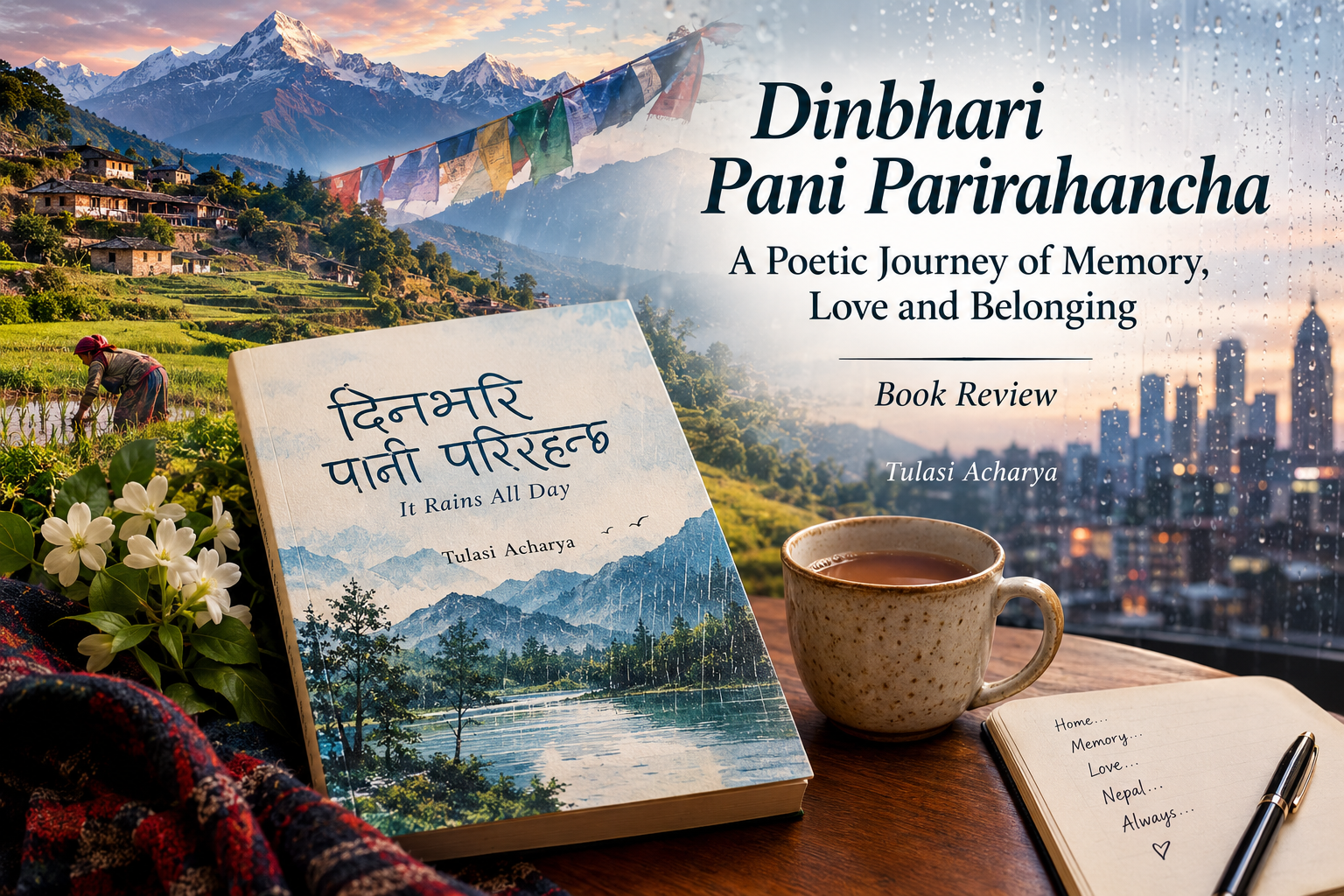
Dinbhari Pani Parirahancha: A Poetic Journey of Memory, Love, and Belonging | Tulasi Acharya. Reviewed by Radhika Kalpit.
When one reads Acharya’s poems one after another and reaches the end, one realizes that this is not merely an ordinary story about rain. Here, “the rain continuing to fall” is not simply a natural process; it is an unceasing flow of human sensitivity and experience. It is the gentle rhythm of the poet’s personal memories and a wave of his emotional consciousness. Dinbhari Pani Parirahancha (It Rains All Day) is poet Tulasi Acharya’s newly published collection of Nepali poetry. In this work, “water” is not merely physical water but emerges as a powerful image reflecting a bygone period of life. Remembering the days of cutting grass in the village and walking barefoot while living in a magnificent American city is not merely a fleeting recollection of moments that have passed; rather, it is a continuity of life, flowing quietly like a gentle breeze.
The work brings together a confluence of personal experience, profound love for the homeland, deep reflections on life, and a strong sense of social consciousness. In particular, the reality of how the heart of a sensitive poet struggling on foreign soil beats and aches has poured forth here through the craft of words. The poet’s country, village, home, family, childhood, and pages of the past are woven together so vividly that, when viewed as a whole, they resemble a beautiful collage etched onto the canvas of the heart. The present of life abroad and the past revealed through memory are engraved into each letter of these poems. The quiet tension between these two periods of time constitutes the principal emotional landscape of the collection.
Memories of the poet’s childhood, rural surroundings, fields and farmlands, rice planting, family, and countless experiences associated with Nepal spill freely across these pages. At times, they flow through a sharp poetic current; at other times, they take the form of reflective prose. Somewhere, they appear as concentrated points of immense emotion within brief poems; elsewhere, they meander like a winding mountain river, flowing smoothly as recollection. Another notable feature of the collection is the poet’s exuberant love for his nation. Poems such as “Dashain Abroad,” “My Father’s Cap,” “A Letter to Father,” “The Fragrance of Dashain,” “After All, I Am Nepali,” “Living Mother,” and “A Promise to Return to Nepal” (all are translated titles from Nepali to English) reveal his deep devotion to his homeland.
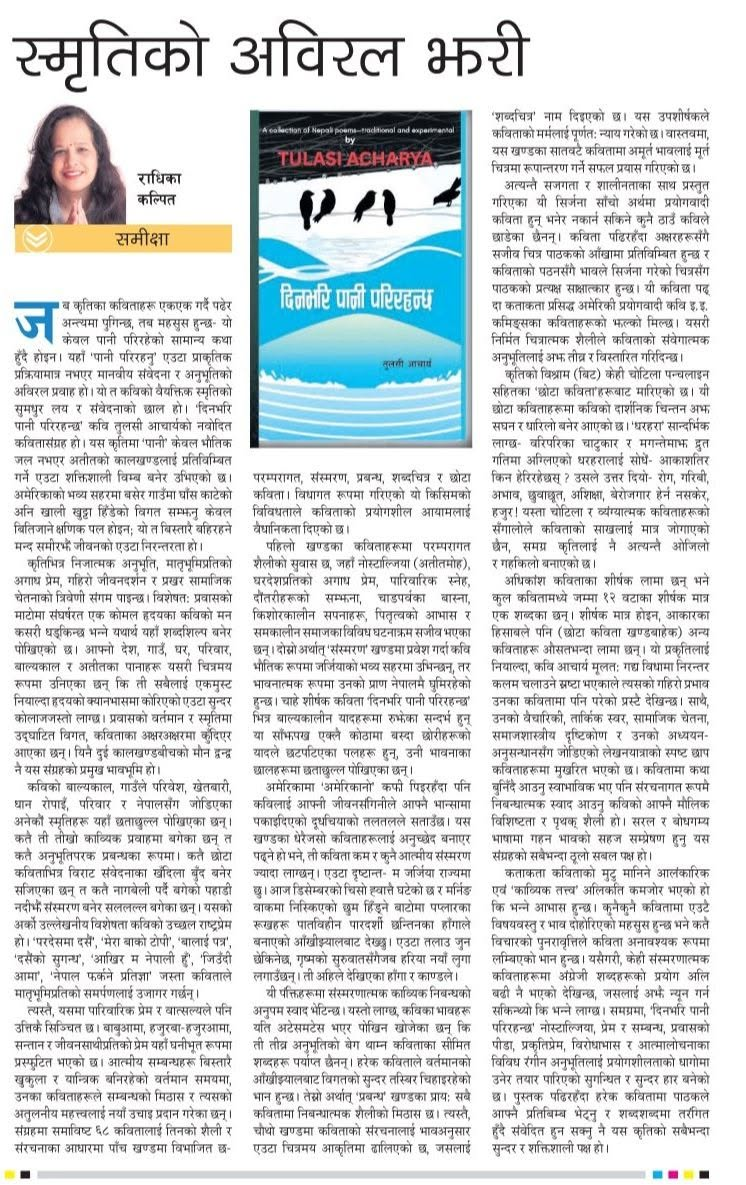
The collection is equally nourished by familial love and tenderness. His love for parents, grandparents, children, and life partners emerges with great intensity. At a time when intimate relationships are gradually becoming looser and more mechanical, his poems elevate the sweetness of human relationships and their immeasurable significance to a new level. The 68 poems in the collection are divided into five sections according to their style and structure: “Traditional,” “Memoir,” “Prose,” “Word-Pictures,” and “Short Poems.” This genre-based diversity lends legitimacy to the collection’s experimental dimensions.
The poems in the first section carry the fragrance of a traditional style, bringing to life nostalgia for the past, profound love for home and homeland, familial affection, memories of friends and companions, the scents of festivals, adolescent dreams, the dawning awareness of fatherhood, and various events of contemporary society. As we enter the second section, “Memoir,” the poet stands physically in the magnificent state of Georgia, but emotionally, his soul continues to wander through Nepal. Whether it is the childhood memories soaked into the title poem, “Dinbhari Pani Parirahancha,” or those moments of restlessness when he sits alone in his room in the evening, longing for his daughters, he spills himself freely into waves of emotion.
Even while drinking an Americano in America, the poet is haunted by his craving for the milk tea his life partner used to prepare in their own kitchen. If many of the poems in this section were read as paragraphs, they would seem less like poems and more like intimate memoirs. Consider, for example:
I am in the state of Georgia.
Today the cold of December
has suddenly eased, and
Advertisement
I have gone out for my morning walk.
Along the path, I see poplar trees stripped
of their leaves, their transparent branches
forming a window through which
I can see a lake that
will be hidden when,
at the beginning of summer,
the trees put on their new green clothes.
These lines offer an exquisite taste of the poetic memoir-essay. It feels as though the poet’s emotions are so tightly packed and eager to pour out that the limited words of poetry are not sufficient to contain the force of his intense feelings. Each poem seems to peer through the window of the present toward a beautiful picture of the past.
Almost all the poems in the third section, “Prose,” possess the sweetness of an essayistic style. Similarly, in the fourth section, the structure of the poems has been shaped into visual forms according to their emotional content, and this section is aptly titled “Word-Pictures.” The subtitle does complete justice to the essence of these poems. Indeed, all seven poems in this section represent successful attempts to transform abstract emotions into concrete visual images.
Presented with extraordinary care and restraint, these creations leave no room to deny that they are, in the truest sense, experimental poems. As one reads, vivid images emerge before the reader’s eyes alongside the letters, and the reader encounters directly the visual forms created by the emotions of the poems. Reading these poems occasionally evokes the work of the renowned American experimental poet E. E. Cummings. This pictorial style intensifies and expands the emotional experience generated by the poems.
The collection comes to its close with the “Short Poems,” some of which contain striking punchlines. In these brief poems, the poet’s philosophical reflections become even denser and sharper. “Dharahara” is particularly relevant:
I asked Dharahara, the tall tower in Nepal
rising rapidly amid flatterers and beggars around it,
“Why do you keep looking toward the sky?”
It replied,
“Because I cannot bear to look at
Advertisement
disease, poverty, deprivation,
untouchability, illiteracy, and unemployment, sir!”
This collection of sharp and satirical poems not only preserves the dignity of poetry but also gives the entire work remarkable force and substance
Most of the poems have long titles, while only twelve of the poems have one-word titles. Not only are the titles long; in terms of length as well, most of the poems—apart from those in the “Short Poems” section—are longer than average. Looking at this characteristic, it is evident that the poet Acharya is fundamentally a writer who has continuously worked in prose, and that this background has had a profound influence on his poetry as well. His intellectual orientation, logical voice, social consciousness, sociological perspective, and the unmistakable imprint of his writing journey rooted in study and research are all strongly expressed in these poems. Although it is natural for narratives to emerge within poetry, the distinctly essayistic flavor of the poems at the structural level is the poet’s own original characteristic and distinctive style. The effortless communication of profound emotions through simple and accessible language is the greatest strength of this collection.
At times, one gets the impression that the figurative and “poetic elements”—often considered the heart of poetry—could have been somewhat stronger. In some poems, the same subject matter and emotional themes seem to recur, while elsewhere, repetition of ideas makes certain poems feel unnecessarily extended. Similarly, some of the memoir poems appear to use English words rather more frequently than necessary, and perhaps this could have been reduced further.
Overall, Dinbhari Pani Parirahancha is a fragrant and beautiful garland woven from the many-colored experiences of nostalgia, love and relationships, the pain of living abroad, love of nature, contradiction, and self-reflection, all threaded together through experimentation. As one reads the book, the fact that readers can discover their own reflections in each poem and become emotionally moved, word by word, is perhaps the most beautiful and powerful aspect of this work.
This collection was reviewed by a published and award-winning poet Radhika Kalpit. It was originally written in Nepali and published in Annapurna Post here. The author of this book translated this review into English. The book is available on Amazon and elsewhere. Your review is highly appreciated.